What regenerative farming means and what to ask a farm
Published Oct. 21, 2026
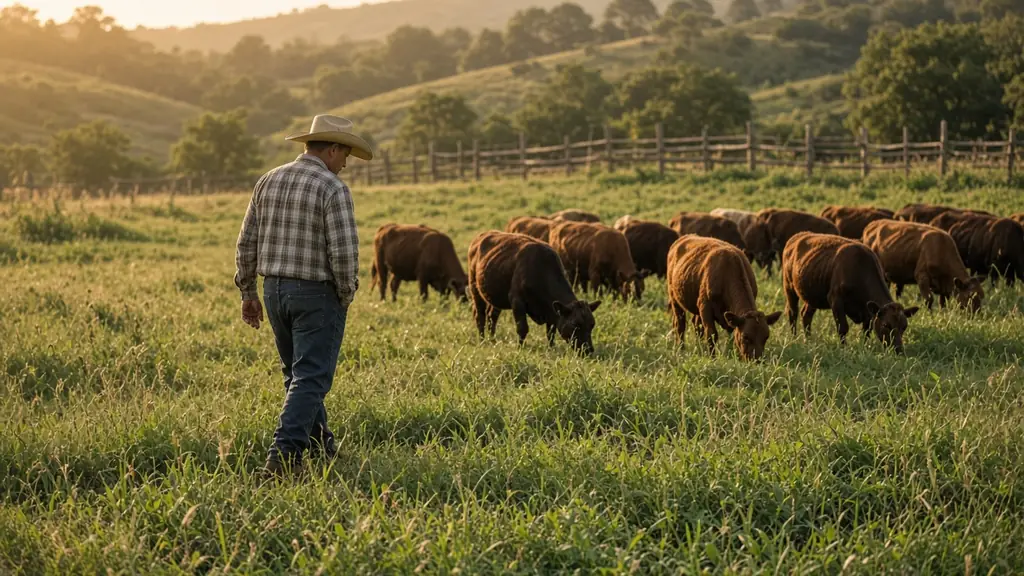
Illustration. It does not show a listed farm or person.
More farms describe themselves as regenerative. The word sounds precise, but it is not. This article explains what the term generally means, which practices it usually covers, how it relates to grass-fed and pasture-raised meat and what shoppers can ask before they buy. It also highlights several farms in this directory that describe their own work as regenerative.
Note: Grass Fed Directory does not verify certifications or inspect farms. The farm descriptions below come from the farms' own websites. Confirm details with each farm before you buy.
No legal definition
There is no federal legal definition of regenerative agriculture. A July 2025 Congressional Research Service report found that neither "regenerative agriculture" nor "regenerative organic agriculture" has been codified in federal or state statutes or regulations, that there is no widely accepted consensus on how to define the terms and that regenerative principles are not enforceable under federal programs overseen by USDA or the Food and Drug Administration (Congressional Research Service). "Organic," by contrast, has a federal definition and a USDA certification program.
USDA's Natural Resources Conservation Service does run a Regenerative Agriculture Initiative. It describes regenerative agriculture as a conservation approach built on soil health, water management and biodiversity. The initiative offers technical and financial help to farmers who assess the whole farm and work toward a whole-farm plan, use at least one listed practice and test their soil in the first and last year of a contract (NRCS Regenerative Agriculture Initiative). That is a conservation program, not a label standard. A farm can call itself regenerative without joining it.
Common practices
Most definitions center on soil. NRCS describes soil health as the continued capacity of soil to function as a living ecosystem and says practices that reduce disturbance, maximize cover, promote biodiversity and support living roots are key to maintaining and improving it (NRCS soil health). On livestock farms, that usually means some mix of these practices:
- Rotational or adaptive grazing. Animals graze one paddock for a short time and then move, so the grass gets time to regrow. Adaptive grazing times moves to pasture conditions rather than a fixed schedule. NRCS lists prescribed grazing among the practices that qualify for its initiative.
- Cover crops. These are plants grown to keep the ground covered between cash crops or to add forage. NRCS says cover crops support soil conservation and soil health.
- Minimal tillage. Farmers plant with little or no plowing, often with a no-till drill, to limit soil disturbance.
- Biodiversity. Farms grow mixed pasture plants, raise several livestock species on the same land and leave room for wildlife and pollinators.
- Fewer synthetic inputs. Many regenerative farms say they limit synthetic fertilizers and pesticides. Rules vary by farm and program.
What the research says about soil and carbon
Claims that grazing can pull large amounts of carbon into the soil are common. The evidence is still developing and is mixed. A 2021 study of grazing lands in the Southeast found higher soil carbon and nitrogen stocks on farms using adaptive multi-paddock grazing than on conventionally grazed farms (Mosier and others, Journal of Environmental Management). A 2026 systematic review took a stricter look at study quality. The 10 studies that met all of its criteria showed no change in soil organic carbon, and the authors concluded that stronger evidence is needed before claiming climate benefits from alternative grazing (Sanderman and others, Communications Earth and Environment). A 2017 report led by the Food Climate Research Network at the University of Oxford found that grazing can store soil carbon only under very specific conditions. Even then, the report said, the gain is small, time-limited and reversible and is substantially outweighed by the greenhouse gases the animals produce (Oxford Martin School).
In short, regenerative practices may improve pasture and soil on a given farm, but broad climate claims are not settled.
How it relates to grass-fed and pasture-raised
The terms describe different things. Grass-fed and grass-finished describe what cattle, sheep and goats eat. Pasture-raised describes where animals live. Regenerative describes how the land is managed. A farm can be one, two or all three. Grass-fed beef can come from land that is not managed regeneratively, and a regenerative farm may still feed some grain to pigs and chickens, which cannot live on grass alone. Read each claim on its own.
Certifications you may see
Because there is no government standard, several private programs certify or verify regenerative claims. Each sets its own rules.
- Regenerative Organic Certified. The nonprofit Regenerative Organic Alliance runs this program. A farm must first hold USDA organic certification or an international equivalent. The program adds standards in three areas: soil health and land management, animal welfare and fairness for farmers and workers. It has bronze, silver and gold levels (ROC framework).
- Land to Market and Ecological Outcome Verification. The Savory Institute's Land to Market program uses Ecological Outcome Verification, which measures results rather than practices. Monitors check indicators such as bare ground and biodiversity each year and collect soil carbon, water infiltration and plant diversity data every five years (Savory Institute).
- Certified Regenerative by AGW. This is a whole-farm certification from A Greener World. Farms follow an approved regenerative plan, are audited every year and test their soil every year. To carry the seal, a farm's animal products must also be Certified Animal Welfare Approved by AGW (A Greener World).
Many small farms that call themselves regenerative hold none of these. That does not make the claim false, but the farm is the only source. If a certification matters, look the farm up on the certifier's own site.
What to ask a farm
- How often do the animals move to fresh pasture, and how long does a paddock rest?
- What do the animals eat in winter or in a drought? Is any grain fed, and to which animals?
- Does the farm use synthetic fertilizer, herbicides or insecticides on its pastures?
- Does the farm plant cover crops or seed pastures with a no-till drill?
- Does the farm test its soil, and has anything changed since it started?
- Does it hold any certification, and where can that record be checked?
Farms in the directory that describe their work as regenerative
These farms are listed in Grass Fed Directory, and each one's own website currently uses the term. The descriptions below come from those sites and were checked Oct. 21, 2026. None of the claims are verified by the directory.
- White Oak Pastures, Bluffton, Ga. The six-generation family farm says its practices focus on regenerative land management, humane animal husbandry and revitalizing its rural community. It sells grass-fed beef, lamb and goat along with pastured chicken and heritage pork. It also describes a zero-waste system in which it pasture-raises animals and hand-butchers them on the farm (farm website).
- Watson Farms, Chester, S.C. The farm says it uses regenerative practices with its 100% grass-fed and grass-finished cattle. It calls mob grazing, in which the herd stays together and moves daily, its most important practice. Its October 2026 farm notes describe planting winter pasture seed into the sod with a no-till drill and say the farm uses no herbicides or insecticides on its pastures. The farm says its chickens move to fresh pasture daily and its pigs rotate through paddocks and also get a non-GMO grain ration (farm website).
- Southern Ridge Farm, Columbia, Tenn. The farm describes "regeneratively raised livestock" and in-house processing and says it is working to restore soil, recharge waterways and increase biodiversity (farm website).
- Lick Skillet Farm, New Market, Tenn. The farm calls its products "regeneratively raised, pastured proteins" and sells beef and lamb boxes for delivery (farm website).
- Earnest Roots Farm, Ashville, Ala. The farm says it uses regenerative agriculture practices and raises 100% grass-fed and grass-finished beef and lamb along with pastured poultry, pork and eggs (farm website).
- Nature's Gourmet Farm, Petal, Miss. The farm lists "regenerative soil practices" and says its grass-fed and finished beef and lamb get no grain. It also sells pasture-raised pork, chicken and eggs (farm website).
Find more farms on the grass-fed beef page.